ATLAS · Volume I · Published May 2026
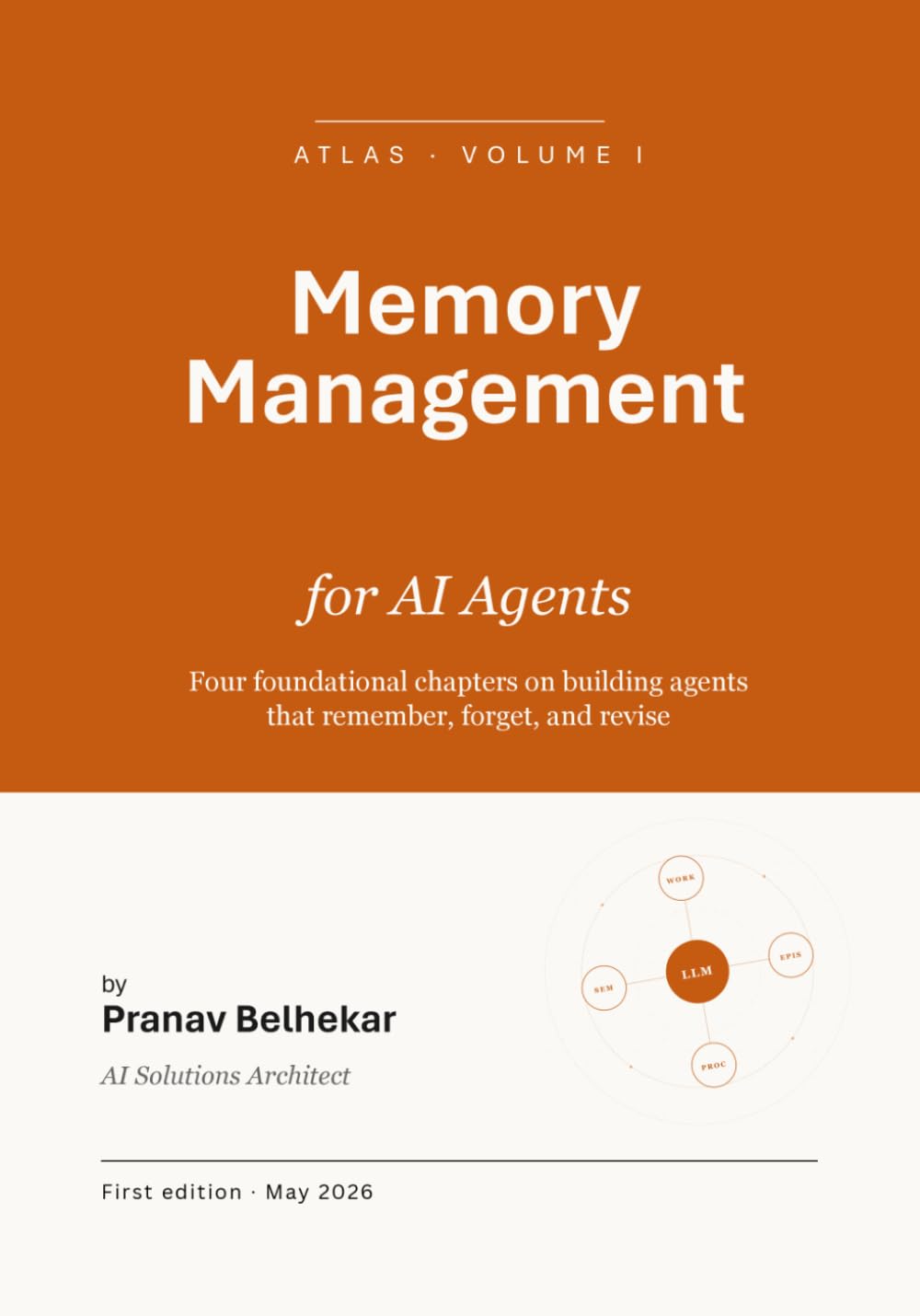
Memory Management for AI Agents
How agents remember, forget, and change what they believe.
Many agent failures begin before the final answer: context drifts, stale facts remain in memory, and contradictions are never resolved. This volume gives each memory problem its own model, failure modes, and runnable code.
- 189 pages
- 4 chapters
- 4 code companions
Digital: free / pay what you want on Gumroad · Print: Amazon
The idea
About the book
A context window is working space, not a durable memory system. An agent that needs to operate across turns and sessions must decide what to retain, what to retrieve, what to forget, and how to revise an old belief when new evidence arrives.
ATLAS Volume I follows those decisions through four forms of memory. It connects the concepts to implementation choices, with a public code companion for each chapter.
Inside Volume I
What you'll take from the book
Four chapters · four public code companions
Each chapter starts with a failure you can recognize in an agent and ends with an architecture you can inspect, test, and adapt. These are the practical ideas at the heart of Volume I.
- Chapter 01 From page 14
Memory taxonomy
Where should each piece of an agent’s memory live?
Separate the context in front of the model from the experiences, facts, and procedures it can retrieve later.
- Choose between working, episodic, semantic, and procedural memory by access pattern and lifetime.
- Design the write, retrieval, and consolidation paths that connect those four tiers.
- Chapter 02 From page 42
Context drift & the hallucination fallacy
Why does a capable model act on the wrong state?
Trace failures that look like bad reasoning back to missing evidence, stale facts, lost plans, or unconfirmed tool calls.
- Diagnose four distinct memory failures from an agent trace instead of treating them as one symptom.
- Carry a bounded, structured state across turns; use durable plan anchors and detectors to catch drift.
- Chapter 03 From page 98
The mathematics of forgetting
What should an agent keep as memory grows?
Make retention a deliberate decision, so an old but critical constraint survives while routine noise fades.
- Rank memories using relevance, time decay, repeated useful access, and intrinsic importance.
- Consolidate repeated experiences and tombstone retired items so their history remains auditable.
- Chapter 04 From page 140
Belief revision & contradictions
What happens when a trusted fact changes?
Resolve conflicting claims at the memory layer, then show which belief is current and why it replaced the old one.
- Represent claims with provenance and time so conflicting facts can be compared by policy.
- Use supersession and historical queries to answer both “what is true now?” and “what did we believe then?”
From Chapter 4
A changed fact shouldn't create two answers.
The book follows a software agent whose team moves from Express.js to Go. If memory only accumulates facts, it can return both frameworks. The worked example shows how a revision layer chooses the current claim while keeping the old one in history.
- 01
The original belief
The agent records Express.js as the backend framework.
- 02
A new instruction arrives
A user updates the framework to Go. The new claim supersedes the old one, with the reason and timing recorded.
- 03
The agent can answer both questions
“What do we use now?” returns Go. “What did we believe in January?” still returns Express.js.
Who it's for
AI engineers and architects building agents that must keep useful state beyond a single turn. If you've debugged an agent that forgot an important constraint or confidently used an outdated fact, this is the problem the book addresses.
Choose your format
Get the book
Digital · Gumroad
Read it today
The 189-page digital volume, available as a free / pay-what-you-want release.
Get the digital edition →Paperback · Amazon
Keep it on your desk
The printed first edition for readers who prefer to work through a technical book on paper.
Get the print edition →